Self-custody, clarified
The SEC quietly published a plain-language guide to crypto self-custody. This issue explores why that matters, how custody defines real ownership, and why understanding private keys is essential to open money, real choice, and financial control.

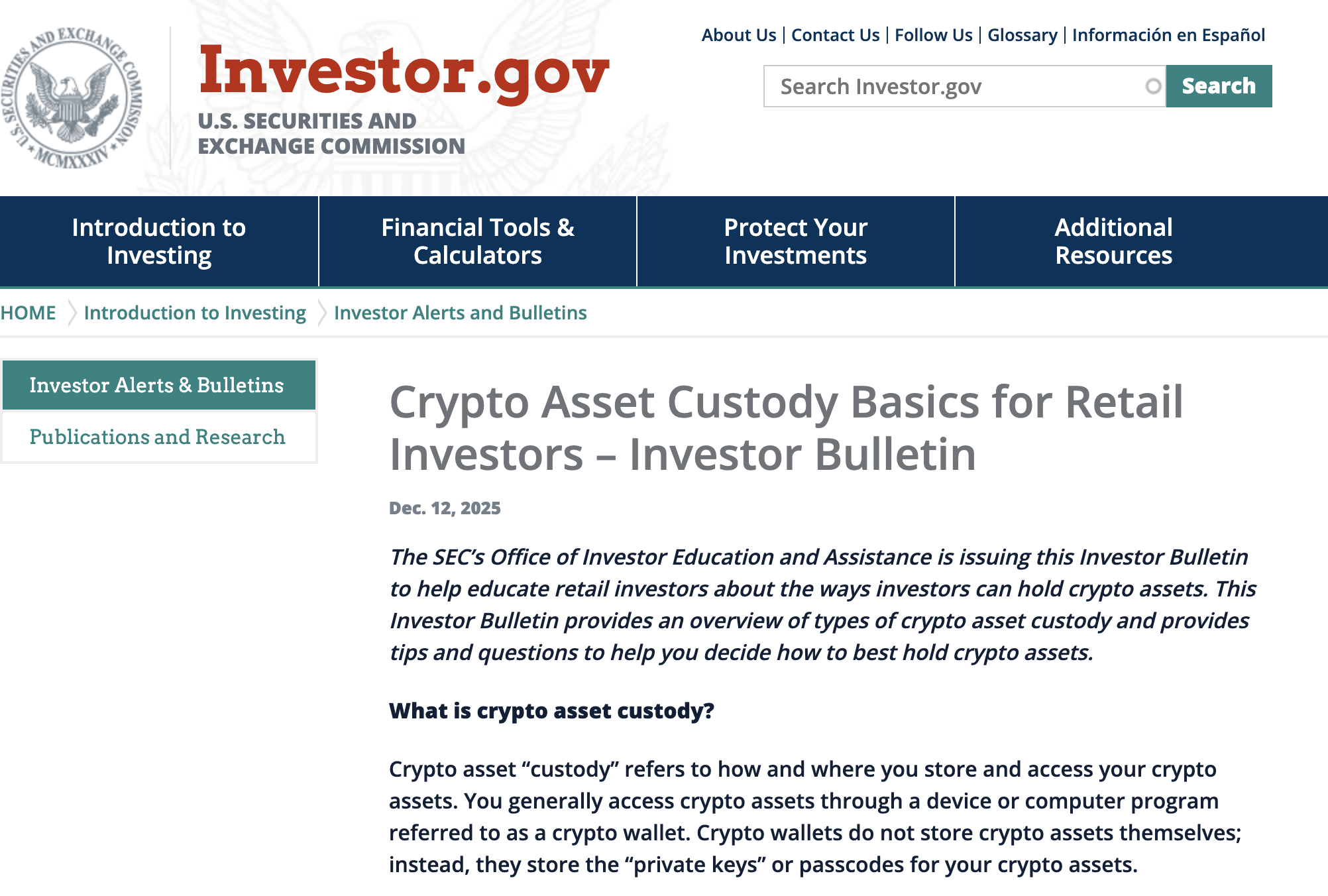
The SEC did something unexpected. On December 12, the financial regulatory body, long at odds with the crypto industry, issued a plain-language bulletin explaining how self-custody of digital assets actually works.
Rather than issuing guidance about how tokens are classified or which assets are securities, the SEC took a direct line to educate investors about one of the fundamental concepts that shapes the power of crypto: how people store crypto, what private keys are, and what it means to have real control over your own assets.
The bulletin isn't fancy or necessarily groundbreaking in the way that it talks about self-custody. Typical of SEC bulletins, the language is spare and measured: “Crypto asset ‘custody’ refers to how and where you store and access your crypto assets.”
But the signal is clear. The SEC is beginning to talk about crypto not just as a regulatory problem, but as a system with internal logic, one that demands user comprehension as much as it demands compliance.
For Open Money, this shift matters. Self-custody is not a user preference or a niche practice. It is the hinge between legacy finance and an open financial system. If you don’t control the keys, you don’t control the money. And if you don’t know that, you aren’t making a financial choice, you’re simply following defaults someone else designed.
Custody is control
For years, one of the core facets of the Open Money framework has been that self-custody is foundational for a better internet. Not just of crypto, but of any system that claims to be open.
In legacy finance, you can access your money, but only through someone else. Banks, brokers, payment rails: access is permissioned and subject to reversal. That was tolerable because there was no alternative.
Now there is.
With crypto, the act of custody, of holding your own private keys, is what enables global peer-to-peer networks to function without gatekeepers. That control is what makes permissionlessness possible. It’s what makes composability and programmability more than abstractions. Without it, the architecture collapses back into trusted intermediaries and central failure points.
It feels odd to quote myself, but this is from an earlier post on the topic: “Self-custody is like a cornerstone of a new kind of financial system built on access, equality, security, and minimal user cost.”
 Daniel McGlynn
From enforcement to instruction
The SEC bulletin marks a subtle shift in posture. For years, the regulator has centered enforcement: which assets violate securities laws, which platforms are noncompliant. This time, it focused on mechanics. The how, not just the what.
It explained the role of wallets, the function of private keys, the difference between storing an asset and storing access to an asset.
“Crypto wallets do not store crypto assets themselves; instead, they store the ‘private keys’ or passcodes for your crypto assets.”
The bulletin acknowledges that owning crypto is not the same as holding a balance in a bank. Control is not an abstraction. It lives in the key. And without the key, ownership is a mirage.
From a high level, the creation of the bulletin suggests that knowing how custody works is a prerequisite to participating in the market and exerting some level of control.
 Daniel McGlynn
The illusion of ownership
Despite billions in market activity, most retail investors still interact with crypto through custodians. They buy bitcoin through apps. They hold tokens on exchanges. They download wallets but never back up seed phrases.
In practice, many don’t control the asset. They hold a claim to it, which can be revocable, restrictable, and sometimes illusory.
The bulletin makes that gap explicit. It walks through the practical components of custody: seed phrases, public keys, private keys. And it names the core tradeoff:
“With self-custody, you have sole control over the access to your crypto assets’ private keys.”
“If you lose your private key, you permanently lose access to the crypto assets in your wallet.”
This is where Open Money has always stood: sovereignty versus convenience. The point isn’t to eliminate risk. It’s to relocate it away from opaque institutions and into user hands, where it’s visible, comprehensible, and yours to manage.
The institutional wrinkle
The bulletin lands in a moment where more investors than ever are gaining exposure to crypto, and in most cases without ever touching it.
Bitcoin ETFs, institutional products, custodial wrappers. These vehicles make crypto accessible to traditional capital. But they do it by designating custody elsewhere. You own shares, but you don't hold the underlying asset.
That isn’t inherently wrong, but it’s a different thing entirely and understanding the difference is important.
The SEC doesn’t criticize ETFs in the bulletin. It doesn’t mention them. But by explaining how custody works, by emphasizing private keys, wallet types, and direct ownership, it clarifies what’s missing when you opt into exposure without custody.
That contrast is quietly powerful. The same regulator that approves institutional vehicles is now teaching users what they’re not getting. That’s not a contradiction. It’s a signal of transition.
 Daniel McGlynn
Knowledge before choice
Open Money is not about advocating that everyone must self-custody. That’s not the point. The point is that people should know what self-custody is before they choose not to do it.
You can prefer the convenience of a centralized app. But that should be a decision—not a default.
The bulletin frames it exactly this way:
“You also need to decide whether you want to manage your crypto assets on your own (self-custody) or if you prefer to have a third-party manage your crypto assets.”
That sentence carries weight. It names the act of custody as a choice. It suggests that knowing how crypto works is part of using it responsibly.
Education won’t settle the custody debate. But it will make the debate visible. And that’s progress.